Ancient divination
Kumalak Ashu
The secret of 41 stones
Qūmalaq ashu is a centuries-old spiritual heritage of the Kazakh people. Explore the tradition through the topics below.
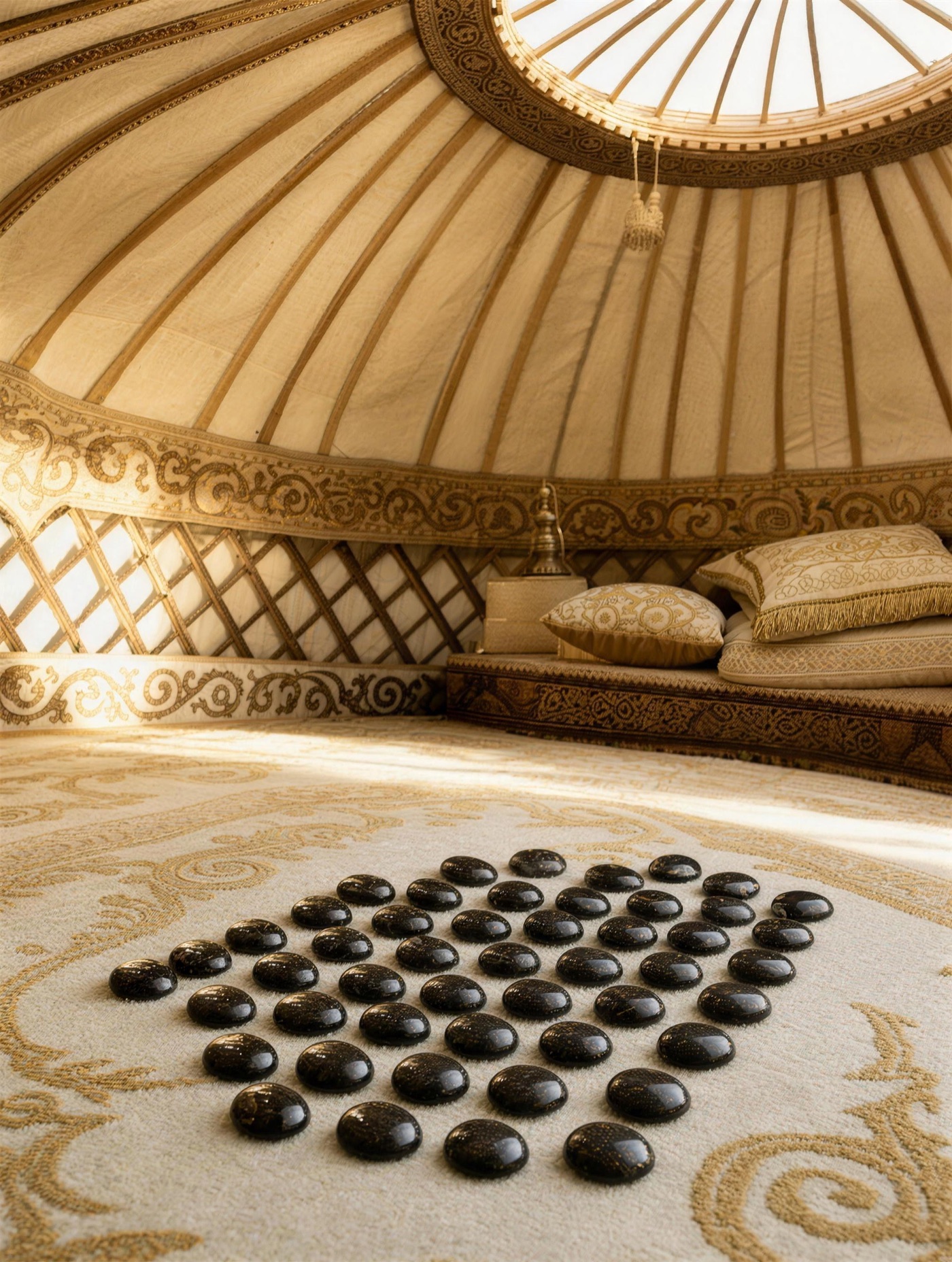
How it works
1
Ask your question
Pick a topic and hold your question in mind.
2
Cast the stones
41 stones fall by hand into a 3×3 field.
3
Receive the reading
The pattern is read through ancient meanings.
Choose a topic








Invite a friend
Send your link. When your friend buys their first reading, you get one free.
Get your linkOne reading per friend, for their first purchase.
About the tradition
Qūmalaq is a traditional Kazakh practice of stone-reading performed with exactly 41 stones. It is unrelated to Western astrology: it has its own history, its own ritual and its own symbolic grammar. The stones are divided by hand into three groups, and the remainders of four form a 3×3 grid.
On the steppe the person who “opened the qūmalaq” was respected — people came for counsel about a journey, a dispute, lost livestock, the future. The tradition passed orally from master to apprentice across generations and is part of the spiritual and ethnographic heritage of the Kazakh people.
The 41 stones are gathered in the palm and divided by hand into three groups. Each group is counted out in fours, and the remainder (1–4) is placed in a cell of the grid. The ritual is repeated three times, forming a 3×3 grid of nine values. The 3D hand in this app reproduces that exact gesture in real time.
A traditional qūmalaq set is exactly 41 stones — which is why it is called “forty-one qūmalaq” (qyryq bir qūmalaq). Pebbles, dried pellets, beans or leather beads were used; what matters is the number and the gesture, not the material. The number 41 is the fixed basis of the ritual.
The number (1–4) in each of the nine cells, and how they sit relative to one another, is what the qūmalaqshy reads. The top row is often associated with the questioner, the middle with circumstances and surroundings, the bottom with the likely outcome. Exact meanings vary from school to school and teacher to teacher — this is not a rigid formula but a living oral art.
Certain patterns of the grid carry their own names and meanings — the symbolic language unique to qūmalaq. A few well-known figures are shown below.
The one who opens the qūmalaq was called a “qūmalaqshy”. People came not with idle but with considered questions; the reading was given thoughtfully, meant to console and to point a way. The tradition carried an unwritten code of ethics: to treat the ritual with respect and never use it to harm.
Stone-reading of this kind — by stones and counting — is not unique to the Kazakhs; close forms exist among the Kyrgyz, Uzbek, Turkmen and other Turkic peoples. That is why the app is built in seven languages: this is shared heritage across the Turkic steppe.
For an urban younger generation this tradition has begun to fade. The app’s purpose is to document qūmalaq and keep it accessible in seven languages (Kazakh, Russian, English, Turkish, Azerbaijani, Uzbek, Kyrgyz), preserving it as cultural heritage for Turkic peoples.
Sacred figure
The tradition has many named patterns. Here are a few well-known examples — their meanings, too, may vary by school and teacher:
Tört Qubyla
Four full corners — protection like a stone fortress, a sign of stability.
Aq Bosaga
A clean threshold — good news, a favourable start to a new undertaking.
Qos Arğymaq
A pair of steeds — luck and support arriving together, in a pair.
Kumalak Ashu lovingly preserves qūmalaq — the living Kazakh art of reading 41 stones. It is a cultural and educational experience: each reading is an invitation to reflect, not a prediction of the future, and never a substitute for professional medical, legal or financial advice. 18+.